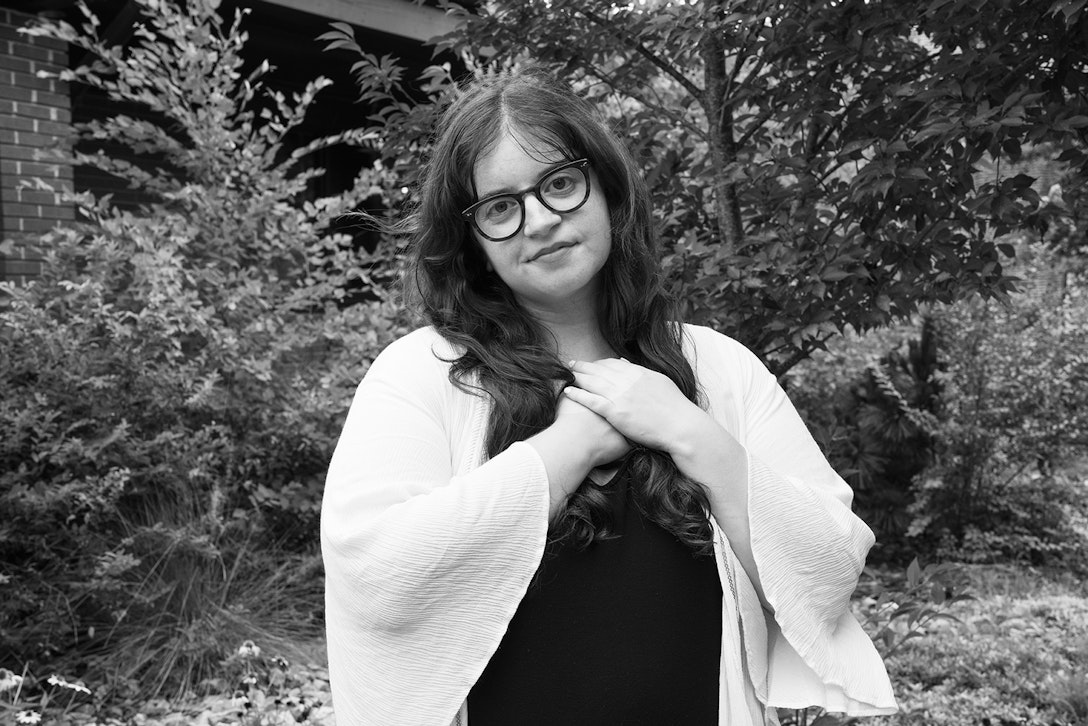
Eliana Light
Durham, North Carolina, USA
THE MYSTERY OF g?d
My concept of God today—and when I say God, I’m imagining a lowercase g?d because that’s the way I like to spell it. This is for me a teaching; a way of understanding it, diminishing the word itself, adding in a bit of the unknown, opening it up to more possibilities. I don’t ever like to use the phrasing ‘belief in God.’ For me, that’s too black-and-white. You either believe or you don’t. For me, it’s an orientation to life. And the truth of life is that we are all connected.
I’m trying to work towards that world of oneness, and I’m not perfect at it, but when I say, “Yod Heh Vav Heh, Echad” in the Shema, that’s what I mean. Yod Heh Vav Heh is like the proper name that we give to God. When I was a kid, I thought, “Oh, well, it’s weird. We can’t pronounce it.” I thought if I pronounced it correctly by accident, I’d be struck by lightning and die. And I know I’m not the only one who thinks that, because I’ve gotten to have a lot of conversations with people about God. But Yod Heh Vav Heh actually does have a root, and it shares a root with ‘being;’ with ‘is.’ My friends and I like to say, “The is-ness;” that which is in life, the quality of being is one, is unified, and it’s all there is.
And I came to that through a lot of tsuris—a Yiddish word for 'hardship’ or ‘heartbreak.’ When I was a kid, God was a dude in the sky with a beard, but like a really friendly guy. So it was never a problem for me that God was like that. God was like an imaginary friend to me who I could always talk to.
As a sensitive child, I felt lonely. I would talk to God like someone might talk to a friend. But for kids, and for all of us, I think, our questions and conceptions of God are really questions and conceptions about how the world works, or how it should work. So, along with that idea of God as the friendly dude, I also thought good things generally happen to good people, bad things generally happen to bad people, and everything works out in the end.
I had that way of looking at the world until I didn’t anymore. When I was 18, my father passed away. I talked about the less-than-ideal circumstances—this is the part of the story—because it wasn’t just his death, it was, I would say delicately, learning that your parents aren’t perfect.
When we are kids, often our conception of God is like our parents but bigger, right? The power that our parents have, but a little more so. And when we realize our parents aren’t perfect, we’re also realizing that God isn’t perfect, because we look around the world and we realize, oh, a lot of good people are in a lot of pain.
Some bad people are doing quite well for themselves. Terrible things are happening in the world all the time. If there’s somebody in charge of this, I don’t know if I can be on board with that. And so that threw my idea of God, and my idea of morality as it works in the world, totally up in the air. And like a lot of people, I thought I was alone in that.
I thought all the adults, all the Jewish adults, had it figured out. We go to synagogue and everybody’s saying the words, like everybody agrees with it. And it wasn’t until I became an educator later that I was able to look back on what happened to me and see that the break—what I started calling the ‘God gap’—the gap between what we think we have to believe about God and the way we see or don’t see that in the world. I was actually not unique in that.
It’s an incredibly universal idea. And it’s actually developmentally appropriate, now that I’ve done a little bit more learning about spiritual development. It makes sense that it happens at that time of life; older middle school, bar/bat mitzvah age (13, 14) when we realize it’s not all that perfect and when we start to search for more meaning in the world at large.
And it doesn’t have to make logical sense. I used to think that I had to have a consistent theology all the time; that that’s what made me intellectually honest. As if, ”This is my idea of God, and it works in every single circumstance, and there are no holes.” I don’t expect that of myself anymore. And I don’t expect that of anybody else because I do believe, as I said before, that God, Divine Spirit, Oneness, is primarily experienced.
Daniel’s Reflection
I interviewed a most amazing Jewish prayer leader, educator, and singer/songwriter, Eliana Light, in Durham, North Carolina. We met when my mother, my sister Julie, and I went to camp Ramah Darom in North Georgia for Passover one year. Eliana was one of the educators and morning prayer leaders. I resonated deeply with her concept she calls the ”God gap” and her moving from writing God first as “God!” then to ”g?d.” What an amazing talent and thoughtful human being. I love her concept that God is “an orientation to life” and that “the truth of life is that we are all connected.”


Explore the portraits by theme
- happiness
- grief
- addiction
- sexuality
- sobriety
- transgender
- alcoholism
- suicide
- homelessness
- death
- aggression
- cancer
- health
- discipline
- abortion
- homosexuality
- recovery
- connection
- enlightenment
- indigenous
- depression
- meditation
- therapy
- anger
- forgiveness
- interfaith
- worship
- salvation
- healing
- luminaries
- shame