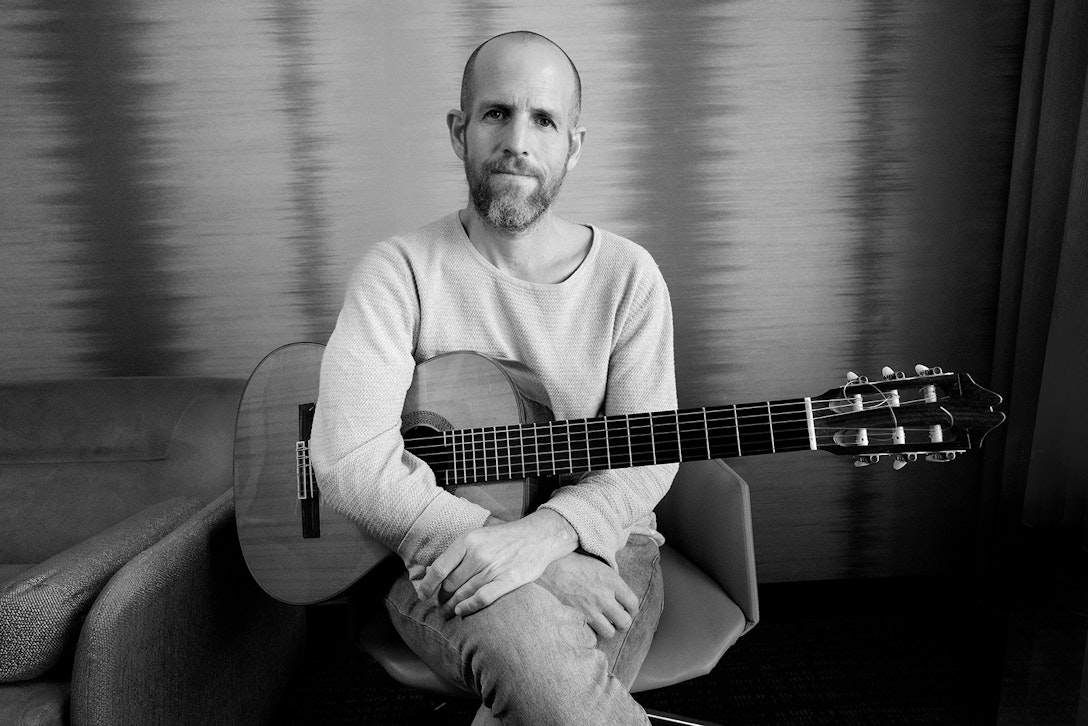
Netanel Goldberg
Mother Earth
IDENTITY CONFLICTS
No one saw me as a child, and I deserved to be seen.
When I put myself on the stage—because this is what my father and my mother did—it was also because of my creativity, but also to please my parents. It’s not by mistake that I’m on stage today. From time to time, I’d been a slave to those acknowledgements.
And this voice talked to me and said, “From now on, you don’t have to be acknowledged, because you’re acknowledged by me. Not anymore. You don’t have to be acknowledged by people anymore. I see you. I’m with you." And I remember myself just crying and crying. But since I was a child, being acknowledged had been my topic.
After that, I went to a concert. It wasn’t full, and I loved it. Why? Because inside the emptiness—all the empty chairs—I saw the Spirit sitting there. It said, “Hey, I’m with you.”
Then, the event was full. It excited me. I sat there and I saw a few people and a lot of empty chairs full of this Spirit sitting there with me. We were all praying together.
So now I am asking, “Am I willing to give up my identity to being Israeli and a Jew for the opportunity to connect to Divinity that connects to all? To connect to the same spirit that gives life to the tree; that gives life to the bird, gives life to people who call themselves Muslims?”
If I am, then I’m connected to all—and to my Israeli, to my Hebrew, to my Judaism. But I don’t belong to it. I belong to the Spirit.
Daniel’s Reflection
I fell in love with the deeply soulful music and singing of Netanel Goldberg several years ago thanks to the YouTube algorithm. Then I had the great honor of bringing him to Cincinnati for a salon concert. Of course, I eagerly took the opportunity to interview him for Portraits in Faith when he came to town. Netanel grew up on a kibbutz, the son of a chazzan (a cantor who leads liturgical singing in synagogue) and a mother who was a singer. Music has influenced all of his life, but his own need for acknowledgement and deep rebellion inside him kept him from sharing those gifts easily for many years. His artistic self manifested over years of being a theater student and being a street performer. But it was his encounter with the Nava Tehila Jewish Renewal community in Jerusalem and rabbi Ruth Kagan that inspired him and gave him a venue for exploring and creating his own music. Netanel’s music transports you to a whole other mystical level of consciousness. It is impossible to be in his presence and hear his music and be unaffected. He is truly tapping into other dimensions.
Given his deep mystical connection to all of creation that he expresses in his songs, I was not surprised to hear of his internal conflict about the war in Gaza and how he had to temporarily remove himself from Israel and go to Greece at the beginning of the war. He posed a question: “Am I willing to give up my identity to being Israeli and a Jew for the opportunity to connect to Divinity that connects to all?”
That question reminded me of Abraham’s arguing with God on behalf of the righteous people of Sodom and Gomorrah “Shall not the Judge of all the earth do right?” (Genesis 18:25, KJV) And this points at the same conflict in myself about Israel and Palestine because I have dear friends who are Palestinian (including an adopted Palestinian ‘mother’) and I struggle with my Zionist identity in these times of violence.
Some people might see this as an academic question but for me it is the most potent of all spiritual questions—to what degree to I identify with the Universal (that I am a human being and a member of God’s creation) versus the particularistic (that I am an Jew, a Zionist, a proud American, a person who aims to be an ethical member of the business community, etc.).
The journey I have been on, not unlike Netanel, has gone from highly ethno-centric and particularistic to much more universal. Mine has been both an intellectual journey and a spiritual and mystical one. The entire idea of our museum exhibition“Portraits in Faith: Seeing The Other” is that there is, of course, no “other.” But I was grateful to read that there are dangers (or at least some naivete) in adopting only a purely Universal stance that forgets all individual identities. It can be naive in ignoring real imbalances of power and resources, asking under-represented groups to give up their struggle for equality. And true society is made up of the great diversity of particularistic identities, not some imaginary general identity. While there is no question that extreme particularism leads to elitism, fundamentalism, prejudice, and war, I cannot ignore my membership and individual identities—be they an ancient culture or a modern day creation. I see my responsibility to bring universal truths to members of my particularistic identity, in this case, to fight for the rights of Palestinians even as a member of the Jewish tribe and culture.
So, I checked back with Netanel since the end of the war in Gaza and he had returned to his home in Israel. I love how he expressed this duality in a note back to me:
Yes, I can say that I feel at home in this complex place—Israel. I know the language, the culture, the diversity, the bureaucracy. Most of my friends are from Israel. Do I belong there? I don’t think so. My longings, my yearning, my search for meaning, and the endless conversations with the spirit teach me that the longing is for the place to which I belong—the place from which I came and to which I will go one day. Belonging is a big word, and one can belong to many places, to many things. In general, the word ‘belonging’—is it ownership? In English it resembles ‘be-longing,’ as if you are longing for that which your heart seeks, as if the soul itself is calling to the Creator for connection.
What is our mission in the world now? And what will remain after we are gone? The generosity, the acts of kindness, the care we gave to others, the ability to see the good, the compassion, what we influenced through our actions for every human being as they are. And now I understand that there are circles of belonging, expanding from the personal to the universal to the divine, and we are called to act within each of them according to our abilities at all times. May it be our will that we build a world here from love.
The mere struggle with this question is beautiful, I believe, and I am grateful to be someone like Netanel who struggles with this question. And it is impossible to ignore that Israel is both a home for Jewish refugees of many generations and a modern military superpower. And those of us who struggle for both survival and thriving of our particularistic Jewish identity and our universal human identity have to hold both of these tensions simultaneously and fight for what is right.


Explore the portraits by theme
- happiness
- grief
- addiction
- sexuality
- sobriety
- transgender
- alcoholism
- suicide
- homelessness
- death
- aggression
- cancer
- health
- discipline
- abortion
- homosexuality
- recovery
- connection
- enlightenment
- indigenous
- depression
- meditation
- therapy
- anger
- forgiveness
- interfaith
- worship
- salvation
- healing
- luminaries
- shame