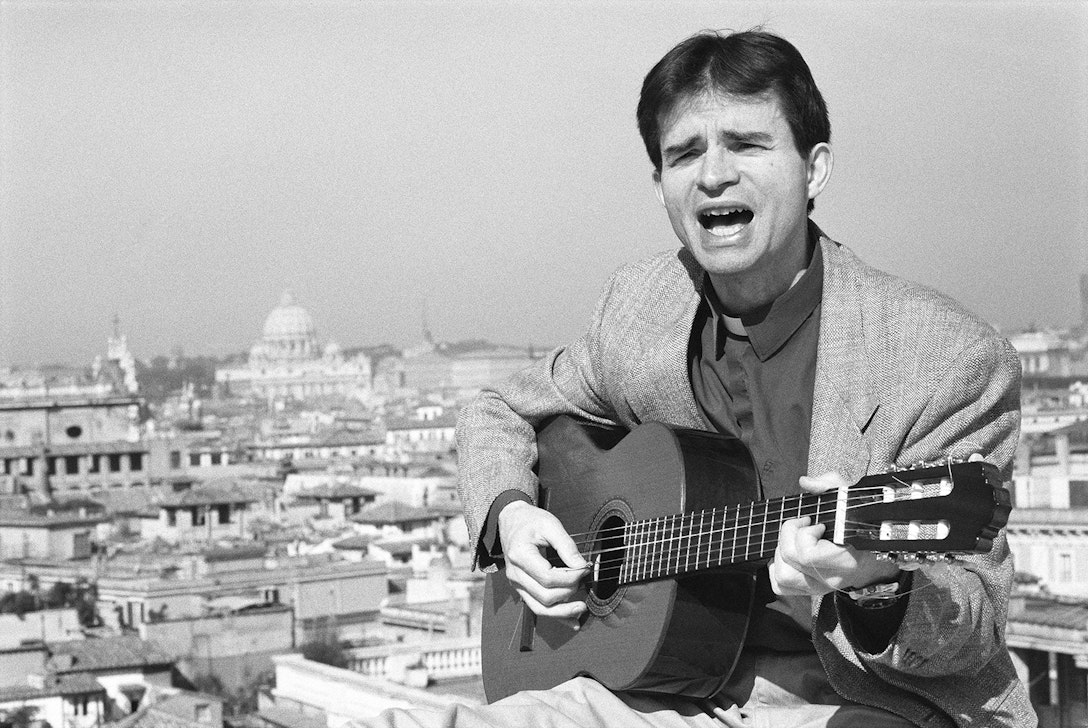
Father Thomas Casey, S.J.
Rome, Italy
GOD IS ANYWHERE HIS CREATION IS
Initially, I felt called to be a monk, to withdraw completely from the world, to go into a monastery to breathe the pure mountain air and to say goodbye to everything. And that was partly the influence of Thomas Merton. And he had such a wonderful way of describing it in The Seven Story Mountain. I think the first sentence was something like, "...I was born into this world of sin...."
I remember, as an adolescent, going to visit monasteries in Ireland. One was a contemplative monastery of Trappists, just like the one Thomas Merton had gone to. And I found one community that was a younger community; it was more vibrant.
And then I met another community. They were older, and the place they lived in was more austere. I thought, “Well, if I’m going to leave the world, I should really leave it.” So, I made a decision to go to the austere place. I had gone back to that monastery and I’d pressured the abbot into being willing to take me in, even though he thought I was a very young soul. When I finished high school, I packed my bags, and I told my parents.
My parents drove me up to the place. My mother went through a lot of Kleenex on the way; crying and saying, “This is ridiculous. This is a terrible idea. What are you up to?”
When we got to the monastery, I discovered there was a new abbot. The man who decreed to take me was no longer an abbot. He was now making jam or something. My father who, perhaps like many Irish fathers, wasn’t saying anything, but he was probably feeling deep emotions inside. My mother was crying profusely. This new abbot looked at my mother as she said, "Gosh, Father, what am I going to do? This son of mine, he wants to come in here and live here for life and he’s only 17."
The abbot looked around, sized up the situation, and said, “There’s no way you can come here at 17 for life. I mean certainly you can come and spend a month here and get to know the monastery.”
My mother said, “Oh thank God! Thank God! I knew! I knew it wasn’t for you."
I said, “A month?”
He said, “Yeah, a month.”
My mother said to me, “Yeah, don’t worry. A month will put this out of your system very fast.”
And it did! After about two or three weeks, I realized this was just a very romantic idealized picture I had of monastic life. When you’re 17, you have this wonderful picture. I was always washing pots and pans with the monks. And it was just the realities of every day. So anyway, that was my initial experience.
I’ve always been attracted to prayer. I think that’s one thing that attracted me to the contemplative life. I’ve always actually enjoyed speaking to God, or being in communion with God. But somehow, I ended up joining the Jesuits. I suppose, at the beginning, I made a leap of faith. A leap into the dark. After my bruising encounter with contemplative life and finding it wasn’t for me, I felt, “Gosh, is this for me at all?” And so when I tried Jesuit life, I felt maybe this isn’t for me, but I’ll try it anyway.
What made sense for me, and what I liked a lot about the Jesuit spirit, was this thing that Jesuits talk about that you can find God in all things. God isn’t just in the monastery; He isn’t just up in the pure mountain air, He’s also in the polluted air of Rome or big urban centers. God is where there are people. God is where there’s any trace of what He has created, and if you look carefully, you can find God and God can find you as well.
Daniel’s Reflection
Father Tom Casey is an Irish Jesuit priest and dean of the faculty of philosophy at the Pontifical University in Maynooth. When I met him, he was attending the Gregorian Pontifical Institute of Rome. He even brought his guitar to the interview. Father Casey jammed on some Beatles’ tunes from the rooftop of the institute overlooking the Vatican in the background. What I love most in Father Casey’s interview is his journey from being a 17-year-old enamoured with the vision of an austere monk’s life to being drawn to the contemplative and teaching life of a Jesuit priest. “God is where there are people…and any trace of what He has created.” This is a great reminder to me to “look carefully” to find God and enable God to find me easily.


Explore the portraits by theme
- happiness
- grief
- addiction
- sexuality
- sobriety
- transgender
- alcoholism
- suicide
- homelessness
- death
- aggression
- cancer
- health
- discipline
- abortion
- homosexuality
- recovery
- connection
- enlightenment
- indigenous
- depression
- meditation
- therapy
- anger
- forgiveness
- interfaith
- worship
- salvation
- healing
- luminaries
- shame