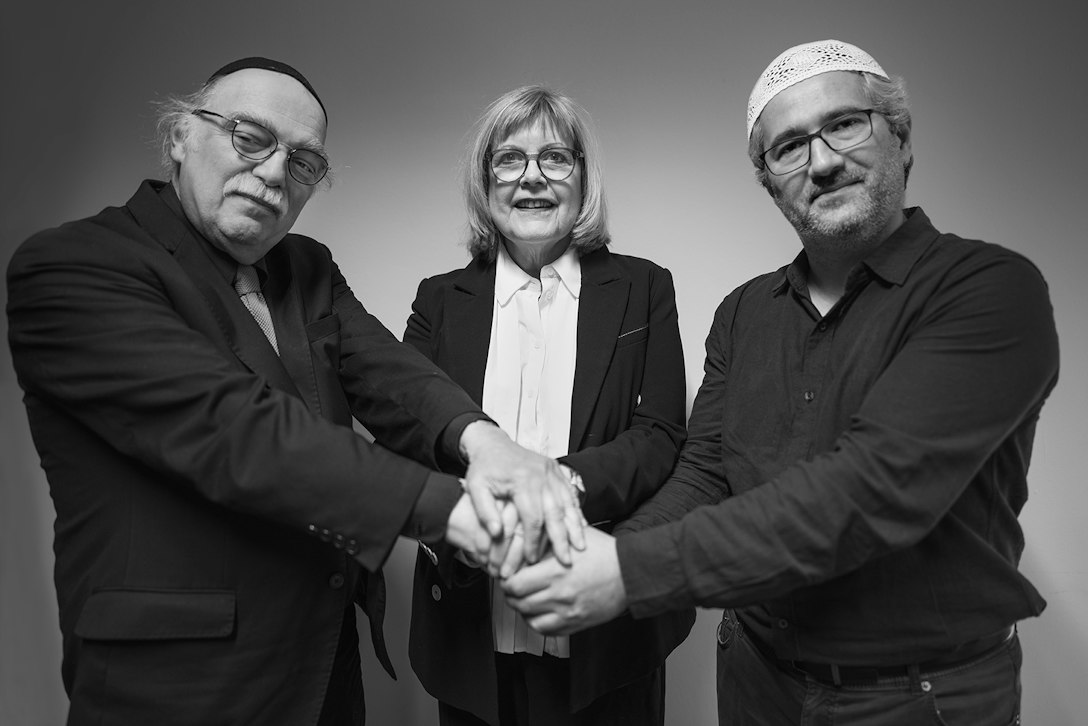
Rabbi Andreas Nachama
Berlin, Germany
COMMITTED TO HISTORY AND TO FAITH
Life without faith is not really possible. You have to survive every day, and if you follow the news, or the noise of the street, you would probably be in a very poor world. So the idea is that behind everything that we do is something that had been created by a heavenly power, and that we are created as an image of this heavenly power, and we have some sparks of that heavenly power in us to make hopefully good things, not bad things. That is really the core of my life I always lived in, with these two legs. On one side is the leg of an historian, on the other side, the leg of a person who teaches people to follow their sparks of being a good person and improve the world. Tikkun Olam.
Daniel’s Reflection
Rabbi Andreas Nachama of Berlin was born in 1951 to Holocaust survivors. His mother survived heavy labor in a prison camp and was hidden in Berlin. His father, Estrongo Nachama, an Auschwitz survivor known as “the singer of Auschwitz,” became chief cantor of Berlin’s Jewish Community. Rabbi Nachama went to the Freie Universität Berlin in the 1970s and earned his doctorate in 1981. He was ordained a rabbi in 2000 in New York through the Aleph seminary (the Jewish Renewal Movement founded by Reb Zalman Shachter-Shalomi). He has led the liberal synagogue in Berlin since the year 2000. In 2015, Rabbi Nachama was named successor to the Jewish founder of the Berlin House of One, a unique project to build a church, a mosque, and a synagogue together in one structure with common socializing spaces in the center of Berlin. It was in this context that I got to meet Rabbi Nechama and his co-leaders of the House of One.
What is fascinating about Rabbi Andreas Nachama is that he is both a professional historian and a rabbi. His most notable project as a historian is the “Topography of Terror,” an exhibit that documents the history of Nazi Germany on the former grounds of the SS/Gestapo. The exhibit carefully documents how the Nazis rose to power and their tactics. It is an outdoor exhibit that is filled with text and photos. Before realizing it was created by Rabbi Nachama, I spent significant time one day on a trip to Berlin going through the exhibit and being impressed by its documentation of details of the history I did not previously know.
Rabbi Nachama says that he lives with two legs: one of a historian where he has documented some of man’s most awful actions, and one of a rabbi where he teaches people “to follow their sparks of being a good person.” I find this very inspiring. He combines how to both be fully in reality and to be fully hopeful.
The House of One is a very interesting project that I deeply admire. It is being built on the site of the medieval St. Peter’s Church. A later version of the church was badly damaged during the war and the East Berlin authorities had it demolished in the early 1960s. It became a parking lot. Excavations of the ancient church site began in the 2000s, and the pastor of the St. Petri-St. Marien parish proposed a multi-religion project. The Berlin Senate ultimately agreed the new structure should celebrate the three religions that were foundational to Berlin.
Today there is a cornerstone at the site and a shipping container that serves as a visitor center for the future location. Amazingly, Rabbi Nachama and his partners, Pastor Mario Gardei and Imam Kadir Sanci, hold programs and prayer services in a variety of locations in Berlin. They created a community prior to the House of One being built. Groundbreaking is scheduled for 2028.
I am grateful to Rabbi Andreas Nachama for his sensitivity to history and his tireless actions on behalf of a better future.


Explore the portraits by theme
- happiness
- grief
- addiction
- sexuality
- sobriety
- transgender
- alcoholism
- suicide
- homelessness
- death
- aggression
- cancer
- health
- discipline
- abortion
- homosexuality
- recovery
- connection
- enlightenment
- indigenous
- depression
- meditation
- therapy
- anger
- forgiveness
- interfaith
- worship
- salvation
- healing
- luminaries
- shame