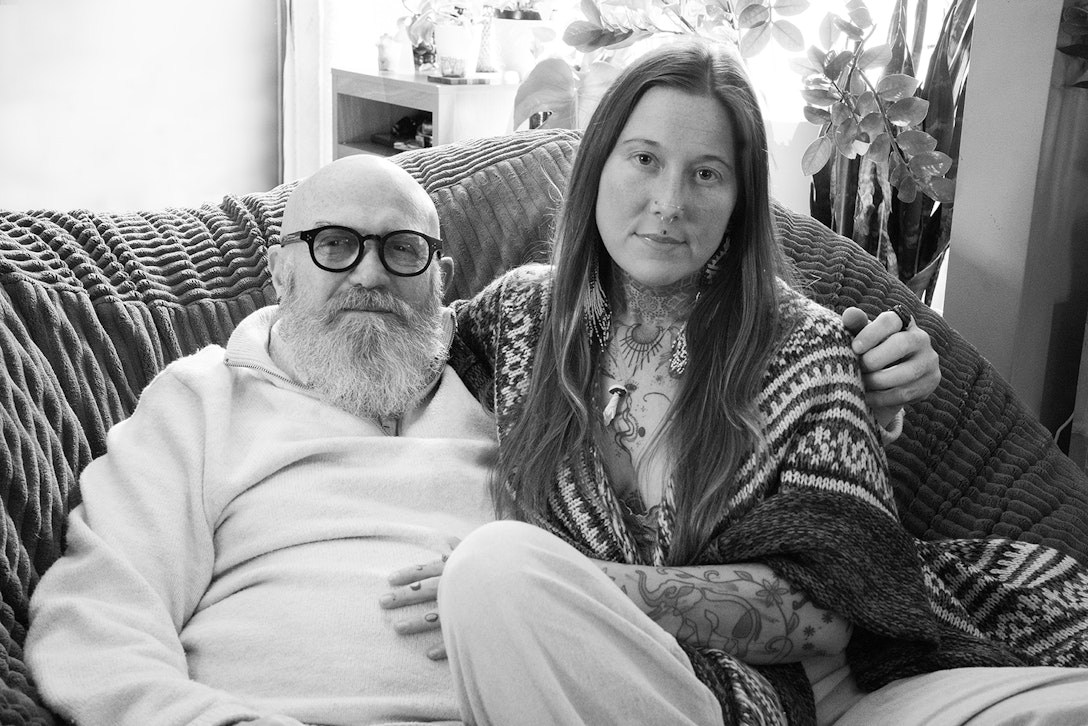
Billy Horton and Kelsey Taylor
Ferndale, Michigan, USA
PSYCHEDELICS AND THE SPIRITUAL JOURNEY
— BILLY —
I drank the cup. It was black. There were about 20 people in the room. It was black. Thirty minutes in, it was dark. If you’ve seen that film where old projectors melt—all that brown went to white. It was like that. And what came through was a bull. It was snorting, and it backed me up against the wall. I was right here with this bull. Then I realized it was not going to kill me, and I could breathe. It said a line that will stay with me the rest of my life, “You are a liar.” The next five hours showed me five lies that I was telling myself, and it really humbled me; put me on my knees.
The beauty of ayahuasca and other psychedelic medicines is that you can’t lie to the medicine. You can’t lie to the spirit in the medicine. It shows you. It shows you, and the purpose of that is not to damage you. It’s benevolent. It’s attempting to take you on a journey to help you locate that light, that essence, that God—what Jesus would talk about—the God that’s in you, God that was in him, the God that’s in all of us, tempting, to help us to see that. The plant medicines, that’s what they do for me. That’s what they’ve done and what I’ve seen them do for other people as well.
— KELSEY —
I started growing psilocybin mushrooms. At that point I was in grad school for public health, but I dropped the thesis I was working on and redirected my attention to using psychedelics as a treatment for addiction—primarily anxiety, depression, trauma—and conducted a survey of people specifically in groups such as psychedelics for recovery, and how these medicines help people with their various pains. I have been in that world ever since.
In studying mushrooms and being with them, I would make microdosing products as a gentle and subtle way for people to start experimenting rather than taking an unknown quantity or a handful in the woods and potentially having a scary experience. I wanted them to be intentional about the experience, and to know what they were taking, empowering them to be in relationship with the medicine—with the mushroom or cannabis, whatever they were working with.
Along the way, I was asked to sit with people who did want to have more of a quality experience. So I did that just for a handful of friends and then a lot of people referred me by saying, “Oh, I know someone who does that.” And it just got around that it was something I did. I provided the mushroom, and helped make people comfortable to have a really safe and meaningful experience—just really honoring the spirit of the mushroom, the spirit of the different plants that they were working with.
Daniel’s Reflection
I have long been suspect of spiritual experiences induced by drugs but I have come to see they constitute a legitimate and possibly much faster and complete path to a sense of unity with all consciousness. I was gifted with greater insight into this topic by plant medicine healers, Kelsey Taylor and Billy Horton, from Detroit. They met at an ayahuasca experience and have worked together ever since. Kelsey and Billy take people on supervised, controlled psychedelic experiences as their professional work and address issues such as addiction and depression.
Modern research on psychedelics took a hiatus after the 1970s. Then a landmark study at Johns Hopkins in 2006 showed that a single psychedelic experience could produce substantial and sustained personal meaning and spiritual significance. It was followed up by a 14-month study to better understand long term effects:
67% of the volunteers rated the psilocybin experience as being among the five most personally meaningful and among the five most spiritually significant experiences of their lives1
At the 14-month follow-up, 58% and 67% of volunteers, respectively, continued to rate the experience as among the top five most personally meaningful and spiritually significant life experiences2
I am deeply jealous of people who achieve the sense of oneness with all that is including a union with the Divine Presence. I have seen pictures of brain scans during a psychedelic trip that suggest people access much more of their brains during such experiences. That information is very compelling to this novice. And, yet, there are risks to psychedelic use. As someone who has benefited greatly from psychiatric medications, I am choosing to not go there…at least not yet.
I went to a session at the 2023 Parliament of the World’s Religions conference in Chicago and Richard Rohr was on a panel about the use of psychedelics for spiritual experiences. He said that if people are experiencing spiritual experiences this way then the church must be concerned with it, too. It is easy for me to imagine that in the coming decades we will know more about the mechanism of action and the biological/chemical nature of a spiritual transformation; the actual chemistry of a change in consciousness. And when that happens, I am sure that psychedelics and traditional spiritual transformation approaches will come together as one approach. So I honor the work of Kelsey and Billy and people like them who seek to provide healing with psychedelics in a safe, controlled environment.
Please note: Portraits in Faith does not endorse, support, or recommend psychedelics or the outcomes from experimenting with them. But we are grateful that legitimate scientific research on psychedelics is moving forward.
References
-
Griffiths, R. R., Richards, W. A., McCann, U., & Jesse, R. (2006). Psilocybin can occasion mystical-type experiences having substantial and sustained personal meaning and spiritual significance. Psychopharmacology, 187(3), 268–283.
-
Griffiths, R. R., Richards, W. A., Johnson, M. W., McCann, U. D., & Jesse, R. (2008). Mystical-type experiences occasioned by psilocybin mediate the attribution of personal meaning and spiritual significance 14 months later. Journal of Psychopharmacology, 22(6), 621–632.


Explore the portraits by theme
- happiness
- grief
- addiction
- sexuality
- sobriety
- transgender
- alcoholism
- suicide
- homelessness
- death
- aggression
- cancer
- health
- discipline
- abortion
- homosexuality
- recovery
- connection
- enlightenment
- indigenous
- depression
- meditation
- therapy
- anger
- forgiveness
- interfaith
- worship
- salvation
- healing
- luminaries
- shame