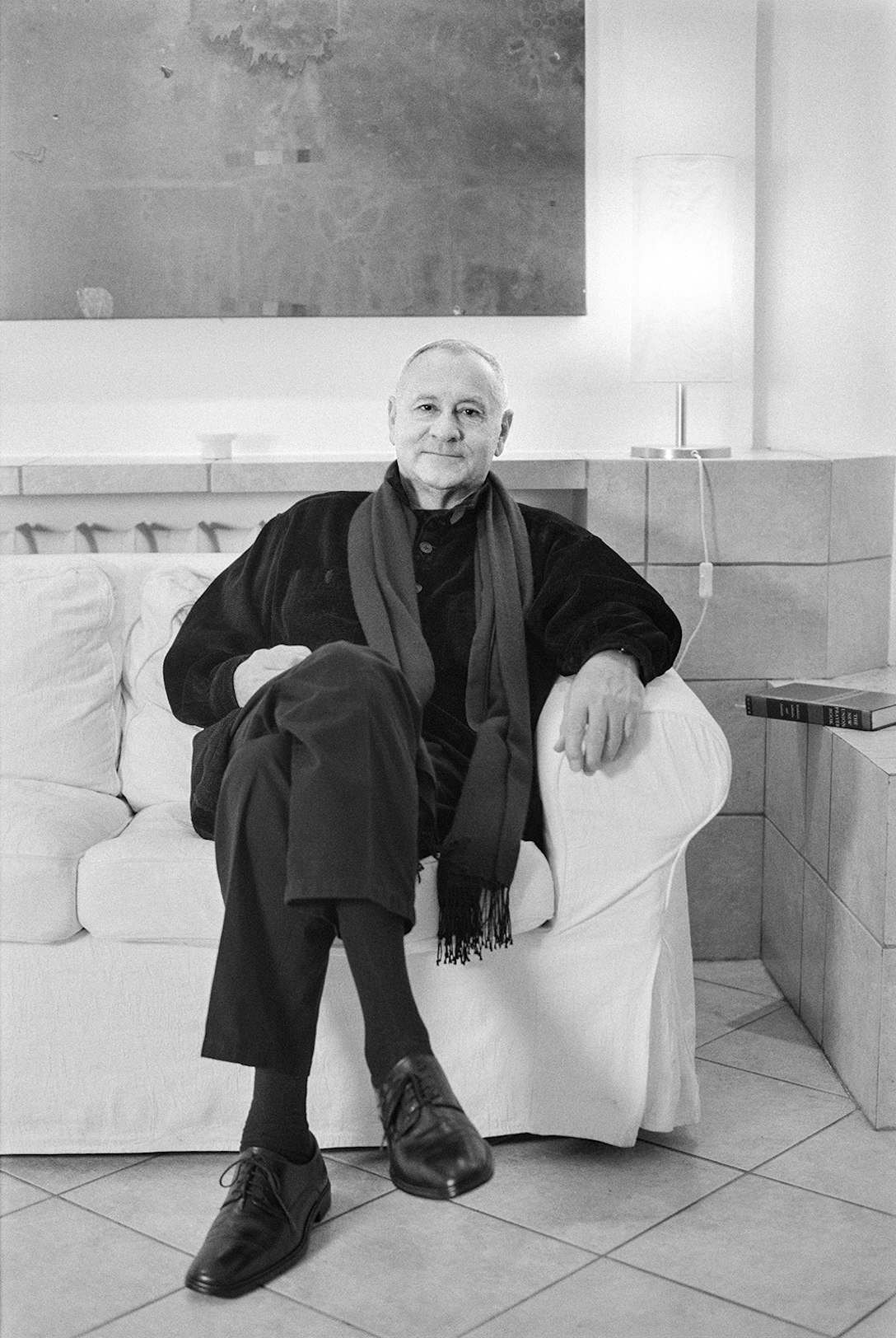
Seweryn Ashkenazy
Warsaw, Poland
I’M JEALOUS OF PEOPLE WHO HAVE FAITH
We survived in a bunker, in a cellar under a cellar in Tarnopol during World War II. I was born in 1936 so I was six years old when we entered the cellar, the sub-cellar, and I was eight when we exited the sub-cellar. At that time, my father rolled up his tallis and his tefillin, his phylacteries, very respectfully, put them in a nice box and said, “There is no God.”
He said that because having seen what we saw, how could there have been a God from our perspective? So that's how we, the family, became atheist. But when it came time to change our name and to abandon the religion we already had the Aryan papers, our name was already changed to be Polonized, so he made the decision that we could not abandon a people and the culture that gave us the basis for hope, and life, and guidelines for education of children and guidelines of life. So we remained Jewish—very Jewish in a sense—but we supported the Jewish religious people, the Jewish causes, synagogues, and so on.
To be an atheist Jew is to be a Jew who knows exactly what his Jewish God, in whom he does not believe, demands of him. So decency becomes the key to your life. And that is something that is intangible, but it changes the person’s life as that person goes on and continues doing that. These do not have big things. In other words, a poor person can help a poorer person and then feel worthwhile; feel worth being in this world, feel worth having been born, feel needed and important for the continuation of this world. If you are richer, then of course you can do more. If you’re very wealthy, then do much more. But I think that that’s what in final analysis it means to have a relationship with God.
Daniel’s Reflection
I met Seweryn Ashkenazy at his Warsaw home but he actually spends more time in Los Angeles. He has made his career as a luxury hotelier and in real estate. As a child, he survived World War II by living in a bunker under a Polish Catholic family’s house for two years.. Today, he is the only surviving member of those who hid in that sub-cellar. Seweryn said his family was “liberal, Orthodox Jewish” before the war, but he remembers when his father put away his ritual objects in the cellar and said “There is no God.”
Today, Seweryn sees himself as a highly identified, but atheist, Jew. He has been deeply involved with the Jewish renewal of Warsaw by hosting the community in his home there. He is also very active with one of the large, Conservative synagogues in Los Angeles. For Seweryn, this involvement and identification is cultural and ritualistic—not theistic. As soon as we had completed the interview, Seweryn exclaimed, “I’m jealous of people who have faith.”
So, what is this idea of the atheist Jew, and what meaning didI derive from our interview? First, there is no faith requirement in Judaism. It is a religion of actions and things to do, not things to believe. There is no concept of salvation other than a generic “world to come when the messiah arrives.” So the religion is more focused on keeping God’s commandments in this life like keeping Kosher or keeping the Sabbath, feeding the hungry, clothing the naked, or redeeming captives. We are told “Naaseh V’Nishma” which means do, then you will understand. Second, human decency is the core of being an atheist Jew. You might think that this is the same as humanism. I know this is what my own father, Howard Epstein, felt in his strong connection to Jewish peoplehood. While I can respect this understanding of faith—a connectedness to a sense of peoplehood and a code of ethics for human decency—I cannot help but feel sadness when I think of Seweryn’s father putting away his ritual objects in the bunker and saying, “There is no God.”
Seweryn Ashkenazy taught me to honor the lesson of pure survival, especially at such a young age. I honor the lesson of adopting a code of moral ethics guided by human decency. And I honor his strong sense of community and Jewish peoplehood to which he is infinitely devoted, almost as a “higher power.” And I honor his honesty about his atheism while he holds in high esteem those who do profess a faith. I am inspired and take refuge in anyone who adopts a moral code of ethics and who puts themselves in service to others.
Thank you to Seweryn Ashkenazy for sitting with me many years ago in Warsaw and sharing with me his story of survival and his truth.


Explore the portraits by theme
- happiness
- grief
- addiction
- sexuality
- sobriety
- transgender
- alcoholism
- suicide
- homelessness
- death
- aggression
- cancer
- health
- discipline
- abortion
- homosexuality
- recovery
- connection
- enlightenment
- indigenous
- depression
- meditation
- therapy
- anger
- forgiveness
- interfaith
- worship
- salvation
- healing
- luminaries
- shame