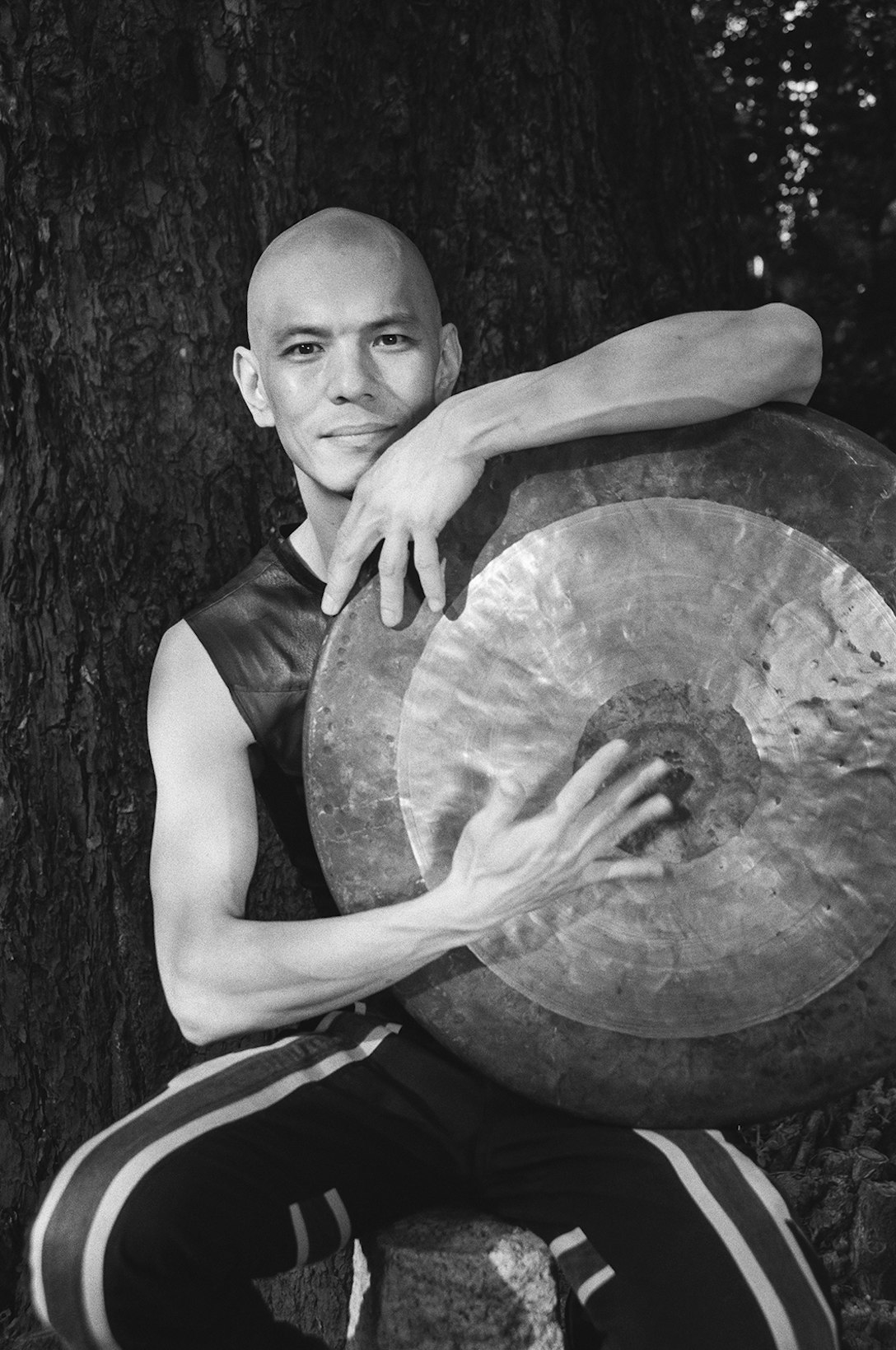
Steve Eto
Nara, Japan
EIGHT MILLION GODS
My philosophy is that I like living in a natural way. For instance, I do not like to fight or have a dispute with anyone. I feel that we are exaggerating the concept of fight or battle. I do not even like watching or doing sports. I do not place a load on myself. I like to live my life at my own pace, naturally. This is exactly how I live my life naturally. However, the music I play I cannot compose without a computer. The music instrument I use, rather than ethnic and traditional tribal ones, are oil drums to put electric elements in my music. It’s not really natural, the sounds I use. But the way I live my life, I like to live naturally.
My father, Haruo Minami, was a musician famous to the Japanese people. He played the Japanese koto, a harp. He went to the United States and stayed there for 10 years. That was when I was born. I grew up watching my father on the stage. I feel that watching him play music influenced me the most. I would say that was my start line.
The first time I picked up a drum, I figured that it would be difficult to go down the same path as my father did. I have seen how wonderful my father was as a performer and knew it would be difficult to be like him. I had no intention to be a musician. But when I thought of being a musician, it seemed to be easy to play the drums. And when I played, it suited me very well.
Actually, I worked with my father in the past on recordings and helping on the stage. His famous line was, “The audience is a superior being.” It means that you gain energy from the audience when you stand on the stage and face them, even when you are not 100 percent fit to perform. I agree with his words completely. Many times when I was not fit to perform at all—magically—I could perform the best ever in front of the audience. For that meaning, even now, when I am asked what my best experience was when working with someone, I always mention Mr. Minami’s name.
I said that I am not a religious person. I like the way of thinking in Shinto belief. Shinto believes gods exist in everything—and it’s said as ‘Yaoyorozu no Kami’—or ‘eight million gods;
too many to count.’ Gods exist in every object on this Earth, like rocks, trees, mountains, and ocean. The fundamental belief is that we act humble and be thankful for everything that exists around us.
I know that during World War II, people had a wrong interpretation of that belief. There is a persistent issue surrounding the Yasukuni shrine to this day. But the fundamental belief has never changed in Shinto. I think this belief is a modern and ecological way of living. To live as a part of nature? I genuinely agree. I love this belief and concept in Shinto. I am not a religious person, but I visit the shrines.
I say that we all should live well and be positive as human beings. There are negativities like wars and conflicts out there in the world. Maybe that is something we cannot control; some things human nature cannot avoid. I cannot say that wars and conflicts are simply wrong. Each of us should try to lead a better life and be kind and thoughtful to the person next to you.
Daniel’s Reflection
Steve Eto was one of the very first people I interviewed on video for Portraits in Faith. Thanks goes to my Japanese producer and friend, Nick Uemura, who had the idea to video these interactions.
Steve Eto is a drummer in Japan who specializes in an industrial sound using found metal objects such as oil drums. While he loves living a natural life, his music depends on computers and found objects. His father was a famous harp player who was blind. Steve was heavily influenced by him, even though he chose to play a different instrument.
Two things stand out about my interview with Steve Eto, even many years later when I am writing this reflection.
The first is his connection to Shintoism. Even though he said he was not religious, he often goes to temples. He even requested that we meet at a Shinto temple. Shinto is the official religion of Japan; it is polytheistic and animist, meaning God is seen in all of creation. The religion was misused during World War II to hold up the emperor as a God in order to inspire loyalty and nationalism. But the religion itself is very rooted in nature and the natural order of life. Through this interview I learned the Shinto idea of “Yaoyorzu no Kami”—there are eight million gods—more Gods than can be counted. It reminds me that all of life is sacred and connected to the Divine.
The second thing that still stands out about Steve Eto’s interview is the wonderful quote of his father’s: “The audience is a superior being.” I love that idea that there is a collective consciousness that comes through in an audience for the performer even, as Steve said, “the performer is not 100 percent fit to perform.” It has now been 24 years since I interviewed and made Steve Eto’s portrait, and I remember it as clearly as yesterday—standing with him on those rocks outside that Shinto temple in Tokyo.


Explore the portraits by theme
- happiness
- grief
- addiction
- sexuality
- sobriety
- transgender
- alcoholism
- suicide
- homelessness
- death
- aggression
- cancer
- health
- discipline
- abortion
- homosexuality
- recovery
- connection
- enlightenment
- indigenous
- depression
- meditation
- therapy
- anger
- forgiveness
- interfaith
- worship
- salvation
- healing
- luminaries
- shame